Before diving in, a quick note: bestcouponblogs may earn a commission when you buy through links on this page, at no extra cost to you, and this does not affect our ratings.
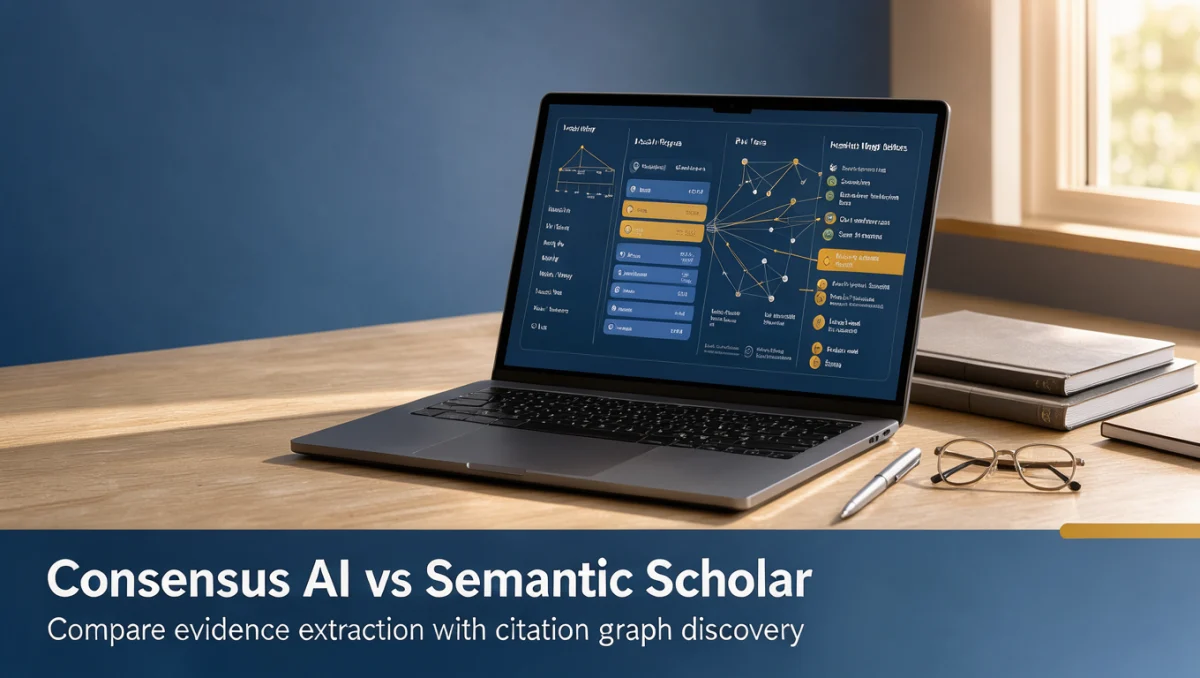
When researchers weigh consensus ai vs semantic scholar, they are really choosing between two philosophies of academic discovery: pulling conclusions out of published studies quickly, or mapping how ideas connect across the scholarly record. Students, analysts, and faculty often lose hours wading through reading lists when a clearer picture of the evidence would save time. As research workflows change in 2026, knowing how each platform handles paper indexing, evidence extraction, and literature mapping helps teams spend their study hours wisely. At bestcouponblogs, we judge research platforms by how well their core mechanics support everyday knowledge work.
Academic discovery tools have split into distinct categories. Traditional indexes emphasize author networks, citation counts, and broad subject coverage, while newer systems answer natural language questions by surfacing extracted conclusions. The right pick depends on whether your project needs quick confirmation of what studies say about a specific question, or a wide exploration of interconnected papers across several disciplines.
Quick verdict: With an overall bestcouponblogs score of 7.7/10, Consensus suits professionals who want concise, evidence-grounded answers to focused empirical questions. Semantic Scholar remains the stronger choice for scholars mapping citation graphs and running thorough interdisciplinary literature reviews. Neither replaces careful manual peer evaluation when methodology must be verified.
| Metric | Platform Assessment |
|---|---|
| bestcouponblogs score | 7.7/10 |
| Best for | Users seeking concise evidence extraction for focused scientific queries |
| Not ideal for | Researchers requiring complete raw citation graph tracking across every discipline |
| Key strengths | Extracting key findings from scientific papers and structuring consensus indicators |
| What to check before buying | Review search quotas and export options on the official website before subscribing |
1. How bestcouponblogs Reviewed Consensus
This review examines what Consensus is built to do, who it serves, and how it compares with similar tools. We applied seven bestcouponblogs criteria: features, ease of use, pricing and value, integrations, audience fit, support, and competitive position. Plans, prices, and limits change frequently, so we flag what to confirm on the official website before purchasing. This article was researched and drafted with the help of AI tools, then reviewed and edited by the bestcouponblogs Editorial Team.
2. Short Answer: Choosing Between Consensus and Semantic Scholar

The core difference between the two tools lies in their primary discovery models. Consensus works as an evidence-focused search engine that pulls conclusions straight from peer-reviewed papers. You enter a question, it analyzes relevant abstracts, and it presents structured takeaways showing where studies agree or disagree. Semantic Scholar, by contrast, is a broad academic discovery index that organizes publications by citation intent, highlights influential references, and traces intellectual lineages across fields.
When choosing an evidence discovery tool, consider where you are in your workflow. If you are drafting a literature synthesis or checking what published studies conclude about a health, science, or policy question, an extraction tool shortens reading time. If you need to trace how a scientific concept developed over decades through author networks, a citation engine serves you better. Following developments in Artificial Intelligence shows that pairing extraction with citation mapping produces the most balanced review process.
3. Positioning Comparison
Understanding where each platform sits in the academic software landscape helps clarify which one matches your project. Both index peer-reviewed literature, but they serve different research intentions and search behaviors.
| Tool | Best for | Core strength | Consider if |
|---|---|---|---|
| Consensus | Targeted research questions requiring summarized empirical conclusions | Extracting key findings and presenting structured takeaway summaries | You need rapid validation of scientific consensus on specific topics |
| Semantic Scholar | Broad bibliographic exploration and citation network navigation | Mapping citation graphs and identifying influential references | Your workflow requires exhaustive academic paper tracking across topics |
To evaluate these platforms accurately, look beyond the search box and examine how results are organized. An extraction platform presents claims supported by cited abstracts, while a bibliographic index presents full metadata, author profiles, and directional citation trees. A reliable evaluation from Best Coupon Blogs emphasizes matching software design to actual task requirements rather than assuming one system solves every academic challenge.
4. Comparison Across bestcouponblogs Criteria
Evaluating research software means analyzing the functional dimensions that shape daily study efficiency. We compare both platforms across our seven criteria to highlight their fundamental design differences.
4.1. Core Features and Search Functionality
Consensus builds its feature set around natural language question answering and automated finding extraction. Users type direct questions, and the platform retrieves studies and highlights specific conclusion statements from abstracts. It categorizes results to show whether findings tilt positive, negative, or mixed on a given hypothesis. This design prioritizes fast interpretation over manual parsing of every individual study.
Semantic Scholar structures its features around deep bibliographic intelligence. Developed by the Allen Institute for AI, it focuses on paper indexing, extracting key concepts, identifying influential citations, and generating automated brief summaries of methodologies and contributions. Rather than judging overall consensus on a single query, it helps researchers gauge a paper's significance within its field by tracing which later publications built on its findings.
4.2. Ease of Use and Navigation
Consensus offers a query experience that mirrors modern search engines. Users without knowledge of Boolean operators or field tags can type full sentences and receive organized study cards with highlighted claims. This removes much of the initial friction that undergraduate students, healthcare consultants, and corporate analysts face when they need quick scientific answers without complex filtering syntax.
Semantic Scholar presents a layout familiar to academic librarians and career researchers. Navigation emphasizes author profiles, citation counts, topic feeds, and reference lists. It is straightforward for anyone used to indexing services, though navigating large citation networks requires a working understanding of bibliometrics to extract full value from the cross-referenced study trees.
4.3. Pricing and Value Assessment
Subscription structures across academic software fluctuate as database partnerships and computing costs change. When assessing Consensus's value, check the official pricing page for current account tiers, monthly query allocations, and access to advanced analysis. Research tools often separate individual plans from institutional licenses.
Semantic Scholar has historically positioned itself as a free research initiative aimed at accelerating scientific discovery. Buyers comparing the two should decide whether an institution-wide subscription to an extraction platform is justified alongside free bibliographic tools. Confirm whether administrative management, enhanced export formats, or higher usage thresholds are needed before committing organizational funds.
4.4. Workflow Integrations and Export Options
Research tools must integrate smoothly with reference managers and document editors to avoid workflow disruption. For Consensus, verify on the official platform how citations export into standard formats such as BibTeX or RIS, and whether direct reference manager integrations require specific plugins.
Semantic Scholar supports standard bibliographic exports and connects with academic registries and open science repositories. Scholars should check whether their reference management application cleanly reads the paper identifiers the platform provides, so they avoid re-entering metadata manually during manuscript preparation.
4.5. Audience Fit
Consensus targets professionals and students who need direct answers grounded in published literature. Medical writers, science communicators, policy advisors, and interdisciplinary students benefit from seeing study conclusions aggregated in one organized view, which reduces the time needed to review foundational claims across disciplines.
Semantic Scholar serves graduate students, university faculty, laboratory scientists, and technical researchers who need exhaustive literature reviews. These users want to know not just what a paper claims, but who cited it, whether those citations extend the methodology or critique the concept, and how author clusters collaborate across institutions.
4.6. Support and Learning Resources
Support in research software varies widely depending on whether a platform runs on a commercial subscription model or as a non-profit scientific initiative. Buyers should review the official Consensus documentation to verify available assistance channels, response expectations, and self-guided help materials.
For Semantic Scholar, users typically rely on community forums, feedback forms, and technical documentation describing index coverage and algorithmic models. Organizations should assess whether their users need dedicated account assistance or whether open knowledge bases provide enough onboarding guidance.
4.7. Competitive Position in Research Workflows
In the broader research software landscape, both platforms hold critical but non-overlapping positions. Practitioners reviewing consensus ai vs semantic scholar often find that the two complement each other rather than competing directly. Many academic teams use Semantic Scholar for exhaustive discovery and citation tracking, then turn to Consensus for targeted claim verification and rapid evidence synthesis.
Other alternatives in this sector focus on visual graph building or conversational document interrogation. Evaluating both platforms within your broader research stack helps you avoid paying for redundant capabilities while filling real gaps in literature synthesis and reference management.
5. How to Decide Between Consensus and Semantic Scholar

Choosing the right platform requires assessing your project scope, timeline, and required depth of source verification. This decision framework can help align your team's needs with the right tool.
5.1. Choose Consensus If Your Priority Is Answering Specific Inquiries
Select Consensus when your workflow involves drafting briefing documents, verifying empirical claims, or preparing client reports on targeted scientific topics. It excels when you have clear questions, such as whether a dietary intervention affects cardiovascular markers, or how remote work policies influence organizational retention. Its core value is turning diverse study conclusions into a structured overview quickly.
5.2. Choose Semantic Scholar If Your Priority Is Field Mapping
Choose Semantic Scholar when you are starting a thesis, conducting a formal systematic review, or mapping how a technical theory developed historically. Its ability to highlight influential citations and group papers by contextual relevance provides the intellectual scaffolding needed for thorough scholarly inquiry across large literature indexes.
5.3. Recommended Hybrid Workflow
Many productive research teams combine both approaches into one literature analysis workflow:
- Begin with an exploratory query on an extraction platform to identify the prevailing scientific consensus and key study claims.
- Note the foundational studies, author names, and methodological controversies highlighted in the initial results.
- Move those primary papers into a citation index to explore their reference trees, related publications, and influential follow-up studies.
- Export complete citation metadata to your local reference manager for formal manuscript compilation and peer-review preparation.
6. Frequently Asked Questions
What type of literature coverage should researchers verify before relying on these tools?
Researchers should check the official source lists and publisher partnerships on each platform to see how well specific fields are covered. Biomedical and physical sciences receive substantial indexing on both systems, while certain humanities, legal studies, and regional journals may be represented unevenly depending on database agreements.
How do evidence extraction tools handle conflicting study results?
Evidence extraction platforms group studies by their reported outcomes, presenting positive, negative, and neutral findings side by side. This layout lets researchers see divergence in the published literature immediately, highlighting areas where scientific consensus remains unresolved or contested.
What should teams consider when budgeting for academic research platforms?
Organizations should review user seat requirements, query volume needs, and export formats on official vendor pricing pages. Teams must decide whether premium workflow features justify a commercial subscription, or whether open-access bibliographic search engines adequately support their project scale without added cost.
Can automated discovery platforms replace manual literature reviews?
Automated platforms speed up finding papers and extracting summary statements, but they do not replace rigorous human evaluation. Researchers must still inspect sample sizes, experimental controls, methodological limitations, and potential conflicts of interest before citing conclusions in formal manuscripts or clinical guidelines.
7. Final Verdict
Evaluating research software means balancing speed against bibliographic depth. Consensus offers an accessible way to synthesize literature by organizing findings into digestible consensus indicators, making it an efficient option for quick evidence gathering. Semantic Scholar provides the foundational bibliographic infrastructure that lets scholars trace academic lineage and navigate citation networks across millions of publications.
| Criterion | Score /10 | Reason |
|---|---|---|
| Features | 8.0 | Extracts findings effectively but focuses on abstracts rather than full methodology exploration |
| Ease of Use | 8.5 | Presents a clean, search-driven interface requiring no specialized bibliographic training |
| Pricing and Value | 7.5 | Commercial subscription terms require verification against specific organizational query volume |
| Integrations | 7.0 | Offers standard export formats while specialized direct reference manager syncs should be checked |
| Audience Fit | 8.0 | Well suited for analysts, students, and practitioners needing fast empirical verification |
| Support | 7.0 | Documentation and help resources require review on the official vendor platform |
| Competitive Position | 8.0 | Maintains a distinct role in evidence extraction alongside traditional citation indexes |
Overall score: 7.7/10
For independent analysts, students, and professionals who need rapid scientific consensus summaries, Consensus is an efficient starting point for empirical inquiry. For career researchers, faculty, and technical specialists conducting comprehensive literature reviews, Semantic Scholar offers the citation graph depth required for rigorous scholarly investigation.
Have questions about choosing research and analysis platforms for your team? Contact our editors at https://bestcouponblogs.com/contact/ or connect with bestcouponblogs on LinkedIn at https://www.linkedin.com/company/bestcouponblogs/ to explore our latest software evaluations.